Thursday, June 18, 2020

Apples


The apple never falls far from the tree

— German proverb


Eric kills endangered animals for sport at taxpayers' expense.

Donald, Jr. raises millions for kids with cancer and pockets it.

Barron—regally nameddepends on blackmail to avoid disinheritance.

These are our current president's sons.

The sons of another wealthy White House occupant, FDR, took far different paths when the nation entered World War II.

Jimmy enlisted as a captain in the Marine Corps and fought in the Pacific as a commando, earning the Navy Cross and the Silver Star. Newspapers called him the “fighting guy." He also served as a troop instructor and an intelligence officer. He served after the war in the reserves, retiring at the rank of Brigadier General.

Elliott, at first deemed 4-F, wangled a desk job in the Army Air Force, but quickly proved himself capable of flying photographic reconnaissance missions, leading the recon operations before D-Day and during the Battle of the Bulge. He flew over 300 missions during the war, was wounded twice, and received the Distinguished Flying Cross. He left service at the rank of Brigadier General.

Antique cup owned by FDR, Jr.
now in this blogger's collection
Franklin, Jr. served in ROTC at Harvard for four years before entering active duty as a Navy ensign. He participated at-sea in the North Africa campaign and the invasion of Sicily and received a Silver Star and Purple Heart. In March 1944, FDR, Jr. was promoted to Lieutenant Commander and took command of a destroyer escort in the Pacific that fought in the Philippines, Okinawa, and Iwo Jima campaigns. Upon his discharge from the Navy, he entered politics, serving as a US Congressman (and collecting antique porcelain).

John joined the Navy in 1941, applying for sea duty a year later. Hearing of his son’s application, FDR ordered that the request be denied. But John persevered and wound up on an aircraft carrier in the Pacific, where he earned a Bronze star and a promotion to Lieutenant Commander. When he learned of his father’s death in April 1945, John chose to remain at his post, rather than going home for the funeral. After the war, John continued his service in the reserves.

Read more about FDR's sons' warfighting experiences.

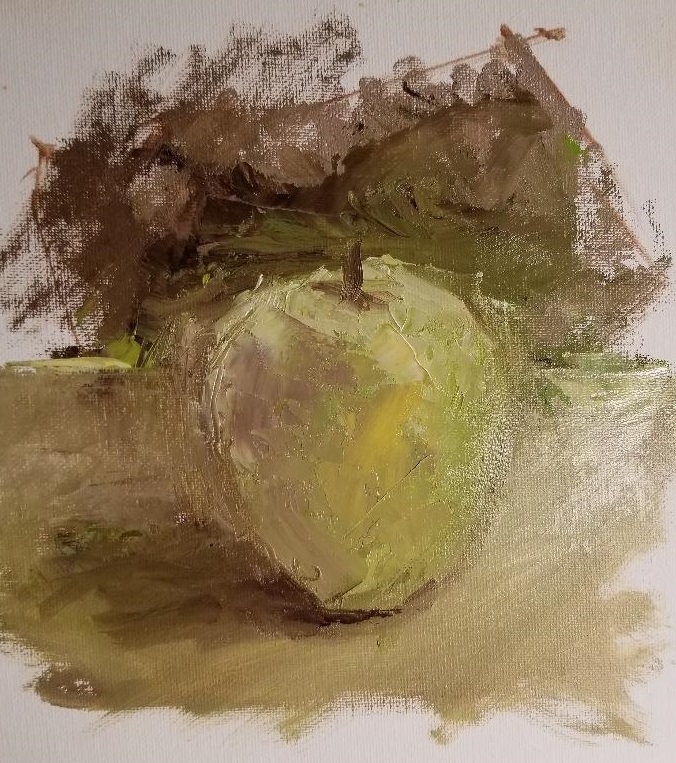
"June Apple" by Robert Francis James. Oil on canvas board.

Wednesday, June 17, 2020

Fake Muse


It is a good thing for an uneducated man to read books of quotations.


— Winston Churchill

When the going gets tough, the tough post quotes.


Many folks I follow on Instagram, Facebook and LinkedIn are forever posting these pith-packets, proving our appetites for the keenly-said are insatiable.

Ward Farnsworth, dean of the U. of Texas law school, calls quotations "little triumphs of rhetoric."

Quotations can give us solace, change our thinking, and move us to act. 

"Quotations when engraved upon the memory give you good thoughts," Churchill said.

But what if a quote is bullshit?

Can it still inspire?

The answer is: yes, it can inspire, at least, some of us. 

In a study of 280 people, behavioral scientists at the University of Regina presented subjects 10 randomly generated "pseudo-profound bullshit statements" (faux quotations attributed to Deepak Chopra, such as, "Imagination is inside exponential space time events”). They asked them to rate each statement's profundity on a scale of 1 to 10. The study concluded that, the more gullible we are—the higher the profundity score we give the fake statementsthe higher our "bullshit receptivity.”

Highly gullible people, according to the study, are not only susceptible to bullshit, but are "less reflective, lower in cognitive ability, more prone to ontological confusions and conspiratorial ideas, more likely to hold religious and paranormal beliefs, and more likely to endorse complementary and alternative medicine."

You need not be gullible, however, to be taken in by a fake muse. Lots of quotations are counterfeit.

Here are my own 10 randomly generated samples:

"Nuts."

When General Anthony McAuliffe was asked to surrender his command at Bastogne, he purportedly sent that one-word reply to his German counterpart; but in fact he replied, "Bullshit." Newspapers couldn't print a profanity in 1944.

"Follow the money."

Deep Throat never advised Woodward and Bernstein this way. Screenwriter William Goldman invented the quotation for "All the President's Men."

“The definition of insanity is doing the same thing over and over and expecting different results.”

Albert Einstein never said this. It comes from AA.

“I have just begun to fight.”

Eyewitnesses indeed heard John Paul Jones shouting at the British, "No quarter!" from his perch on the BonHomme Richard. But never this. A writer invented the quotation 50 years after the fight.

"Play it again, Sam."

Rick Blaine (played by Humphrey Bogart) never uttered these words in the 1942 film "Casablanca." Woody Allen fabricated the line when titling his 1969 play.

“Sometimes a cigar is just a cigar.”

Sigmund Freud smoked 20 cigars a day and would never have bad-mouthed the habit. The quotation comes from another psychoanalyst's footnote to a 1950 article he wrote for the journal Psychiatry.

"Let them eat cake."

Jean Jacques Rousseau, not Marie Antoinette, said this. He wrote it in his diary when the future French queen was only 13, single, and living in Austria. Rousseau attributed the line to Maria Theresa of Spain, who a century earlier had been told by her advisors the local peasants had no bread. "If they have no bread, let them eat cake," she replied. But the Jacobins laid the quote on Marie Antoinette at her trial.

“Nice guys finish last.” 

Leo Durocher was asked by a sportswriter what he thought of the 1946 New York Giants. Durocher said, “Take a look at them. All nice guys. They’ll finish last. Nice guys who'll finish last.” The reporter omitted "who'll."

"Winning isn't everything; it's the only thing."

Vince Lombardi liked to say, "Winning isn't a sometime thing; it's an all-the-time thing," a motto he stole from another football coach, "Red" Sanders. Reporters always tightened the statement.

"The harder he works, the luckier he gets."

Donald Trump never said thisabout himself or anyone else. Sam Goldwyn said, "The harder I work, the luckier I get," paraphrasing an adage he saw in Reader's Digest.

So I hope you're inspired to question everything. In the immortal words of Buddha:

“Believe nothing, no matter where you read it, no matter if I have said it, unless it agrees with your own reason and your own common sense.”

By the way, Buddha never said that.


NOTE: Read a bit more about the faux quotations editors call "quilt quotes."

Monday, June 15, 2020

Blood Dues

Legs and arms and body and bone I pay in blood, but not my own.

― Bob Dylan

Though I'm all in, the willful ignorance of many involved in Black Lives Matter leads me to wonder, if guilt is collective, can't innocence be, as well?

Please stick with me a moment.

As the Bible made clear, the Israelites had zero tolerance for crime. 

A criminal automatically incurred blood guilt, guilt that dogged not only the perp, but for generations his family, city, and nation, until the crime was paid for in blood.

But the Israelites weren't the only crazies running about the ancient world.

Up north, the Celts believed that fairies owed blood dues to their partner, the devil; principle and interest payable in blood every seven years. 

To make good on the debt, fairies kidnapped and killed innocent babes―usually on Halloween―always careful to leave a changeling behind, so unsuspecting parents wouldn't get wise.

And the Ancient Greeks, too, believed in blood dues, blood-payments owed by the gods' children for the havoc the gods wreaked on mankind.

In Germany, at the end of World War II, psychoanalyst Carl Jung introduced the idea that every citizen shared collective guilt for the Nazis' atrocities, an idea our occupation forces exploited.

Philosopher Karl Jaspers doubled down on Jung's idea, claiming atonement was impossible without "acknowledgment of national guilt.”

So, if guilt can be blood guilt, sharable across generations, what about innocence?

Is there no such thing as blood innocence? 

And if blood dues were paid by generations past, aren't the living descendants off the hook for their crimes?

You might say, sure, that's what the whole Christianity thing is about.

But, closer to home, I wonder whether the 1.1 million Americans killed or wounded in the Civil War might have paid in blood for the sin of slavery, leaving their descendants debt free. 

My cousin, six times removed, Michael Folliard, was a New Jersey cavalryman who was captured at Buckland Mills and died from scurvy six months later as a POW in Andersonville. He was only 21.

Is Michael's sacrifice not an emolument that descends to me and my family? 

Or have the six generations separating us erased his blood-payment forever and all time?

What do you think?


Note to readers: As a rule, links embedded in my posts provide sources and facts omitted for brevity's sake.

Sunday, June 14, 2020

Potboiler


Before his death in 2013, the Catholic priest Andrew Greeley wrote over 50 cheesy novels, netting him well north of $100 million.

His second best-seller in 1982 prompted Time's reviewer to skewer "Automatic Andy," who by admission wrote about 5,000 words―nearly one-tenth of a novel―every day.

"Everyone knows that a second novel is by definition worse than a first novel," the reviewer wrote.

"Since The Cardinal Sins was a cheap, tawdry, trashy, sleazy book, you can imagine how bad Andrew Greeley's new novel, Thy Brother's Wife, is. A putrid, puerile, prurient, pulpy potboiler."

A potboiler, according to Cambridge Dictionary, is "an artistic work, usually of low quality, that has been created quickly just to earn money."

To "boil the pot"―write trash―is an 18th century expression that leans on the image of the starving artist who stoops to "put food on the table."

But food wasn't the only thing pot-boiled in the 18th century.

In 1792, "Mad Anthony" Wayne, George Washington's zaniest general and a hero of the American Revolution, was sent by then-President Washington to Ohio to grab land from the Algonquins.
"Mad Anthony" Wayne

Mad Anthony did so with dispatch, but also managed to die of gout in the process.

To protect his body from marauders, his officers buried Mad Anthony in his uniform under a blockhouse on Lake Erie.

Thirteen years later, his son Isaac appeared in a small cart to claim his father's bones. He wished to rebury Mad Anthony in the graveyard of the family church near Philadelphia. 

Isaac hired a digger to exhume Mad Anthony's remains. But upon opening the coffin he found his father's rather rotund corpse intact, too large to transport in the cart. So Isaac hired Dr. James Wallace

Doctor Wallace butchered Mad Anthony and boiled the pieces in a pot. 

Isaac had the reduction, the uniform, and the surgeon's saws buried in the original grave, then packed the bones in a wooden box and took them home for interment.

Saturday, June 13, 2020

Cant


No matter how thin you slice it, it's still baloney.

― Rube Goldberg

"We need to unpack that."

Whenever I hear anyone mouth those words, I want to unpack the trunk where I keep my souvenir shillelagh, so I can pummel him.

The meiotic use of "unpack"―what the speaker really means is, "That's ridiculous"is a prime example of cant.

Dictionaries define cant as "a stock phrase" or "the insincere use of pious words." 

The verb form means "to talk hypocritically" or "to speak in a singsong manner."

Etymologists believe cant derived from the Latin cantare, meaning “to chant.” 

In medieval cathedrals, the cantor directed the chants. That solemn duty required the cantor be ordained; but, with the Reformation, the requirement was dropped. Bach and Telemann, both Protestant laymen, were cantors.

Numerous claims notwithstanding, etymologists do not believe cant derived from Andrew Cant, a 17th century Scottish preacher known for his preposterous sermonizing. 

Cant
That rumor was started a century later by Bishop George Smalridge, who, worried about a wave of "ungentlemanly" canting in Britain's churches, wrote in The Spectator:

"'Cant' is, by some people, derived from one Andrew Cant, who, they say, was a Presbyterian minister in some illiterate part of Scotland, who by exercise and use had obtained the faculty, alias gift, of talking in the pulpit in such a dialect that it's said he was understood by none but his own congregation, and not by all of them."

You could simplify matters by saying cant means "baloney."

It's remarkable: we open our mouths and out flow words whose ancestries are unknown to us.

I can imagine, a century from now, etymologists insisting the word trump derived from a forgotten 21st century US president. 

Trump
They will cite as their primary source an obscure "blog" (blogs were a quaint form of self-publishing on the archaic jumble of plastic and wire known as the "Internet").

Dictionaries thenas they do nowwill define trump as "a card with the highest value in a game."

The verb form will mean "to beat someone" or "to be better, more important, or more powerful than another."

Twenty-second century dictionaries will also define trump as "one-upmanship" or "the art of outdoing a rival by claiming superiority, often insisting one is smarter, richer, and more popular."

Secondary definitions of trump will include "malignant narcissist," "white supremacist" and "TV star" (TV was the predominant form of entertainment before the invention in 2120 of the orgasmatron.)


Powered by Blogger.